
the CASTLES OF BURGUNDY

Designed by Stefan Feld and published in 2011, The Castles of Burgundy quickly became a hit, winning multiple awards and jumping to an overall rank of 17 on BGG, while being the 4th lightest game in the top 20. It is ELITE! When I first played it, I was genuinely shocked at how good it was. The table presence of the new and improved Special Edition may have elevated my first experience. Still, even since that game, I’ve been hooked on the gameplay, playing it endlessly on Board Game Arena. It’s not easy to convince my wife to learn a new game, but I was surprisingly successful with The Castles of Burgundy, and she thoroughly enjoyed it! It's rare for a game to click so quickly with everyone that plays it for the first time; I was raving about how great it was throughout my entire first gameplay. It is the most immediate enjoyment I’ve felt towards a game to date, and for that I have moved it up to my #1 spot on Board Game Geek (BGG).
The game begins with everyone having their own duchy (player board), and you must build adjacently outwards from a starting castle position. Each position in your duchy demands a specific type of tile and a specific number rolled on the dice. You retrieve tiles from a central pool to place in your three-tile storage. The central pool is set up with six sections, all representing a number rolled on a six-sided die, each with its own surrounding tiles that you can draw from. There is also a seventh section with tiles that you can purchase using coins, which I’ll get into later. You start your turn by rolling two dice; depending on the numbers you roll, you can draw a tile to put in your storage or place a tile from your storage into your duchy. If you roll numbers that don’t work well for your strategy, you can increase or decrease the number using workers, which mitigates the influence of luck in the game.
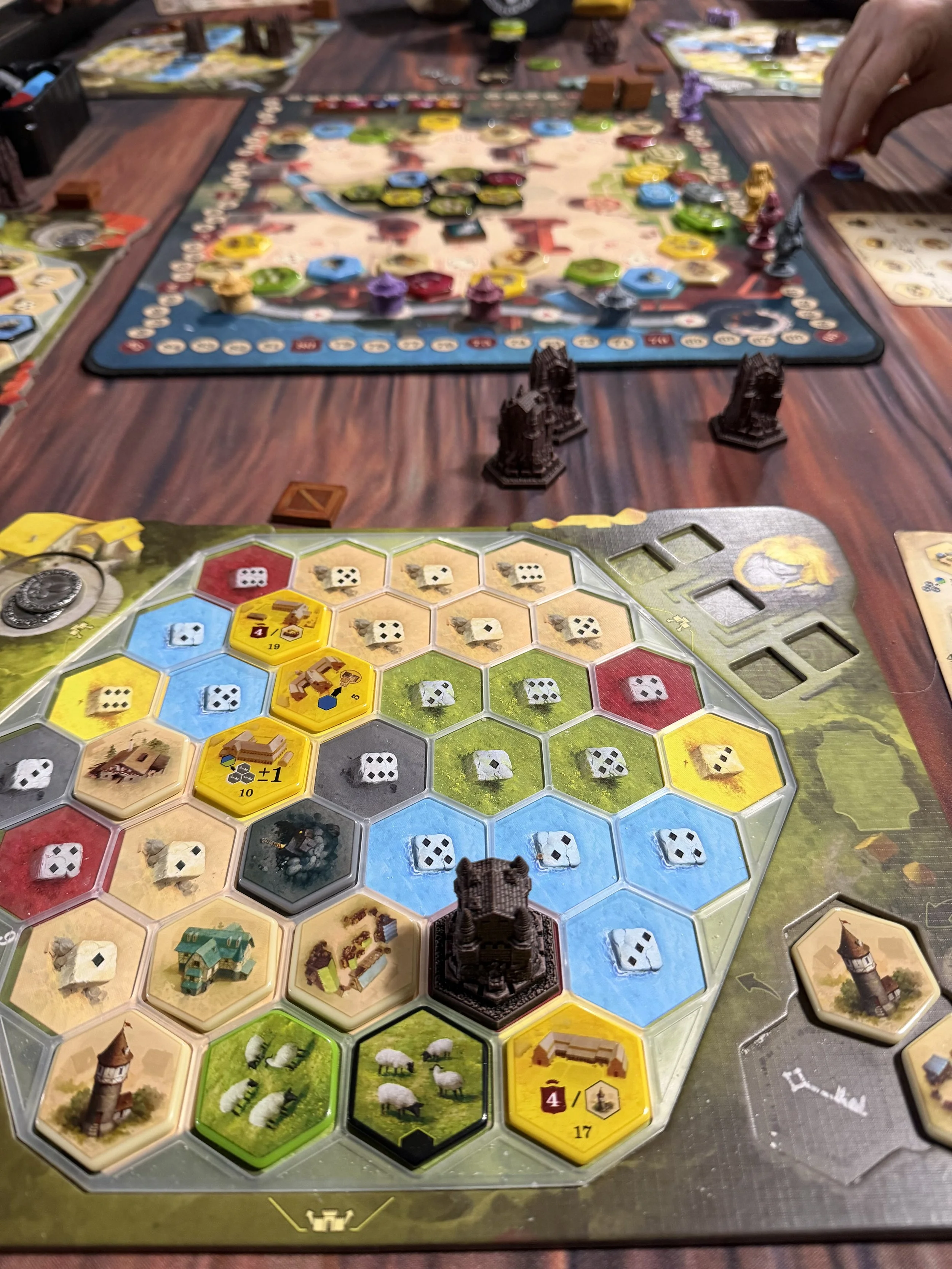
The scoring system is where the strategy really lives, and it's a big part of why the game holds up to repeat plays. There are five phases, with five rounds of turns each, and the central pool of tiles regenerates after each phase. Completing regions with the same type of tiles scores more bonus points during the early phases than during the later phases. Scoring region bonuses, securing mines to earn coins at the end of each phase, and building out your duchy in the direction of your optimal strategy is key in the early stages of the game. Every decision feels like an optimization problem, weighing multiple good options within a limit of 25 total turns that you must plan around. It's the type of experience where you are constantly recalculating your priorities as the available tiles change and your opponents take the actions that you were eying up for your next turn.
The variety of tiles and their bonuses when played keep the game from feeling repetitive. Boat tiles manage turn order and goods collection, which you can sell for coins and extra points. The animal tiles have compounding scoring mechanisms if you pair the same type of animals together in a region. The beige tiles give you so many bonuses and actions, from generating more workers and coins to triggering extra actions like drawing or playing extra tiles. The yellow tiles add significant strategic depth to the game, creating asymmetric abilities and scoring bonuses. Even across multiple plays, the different combinations of tiles and the timing that you play them keep the game feeling fresh and enjoyably replayable. I recommend this game to anyone and everyone, literally.
-Mark Krabben
July 31st, 2026